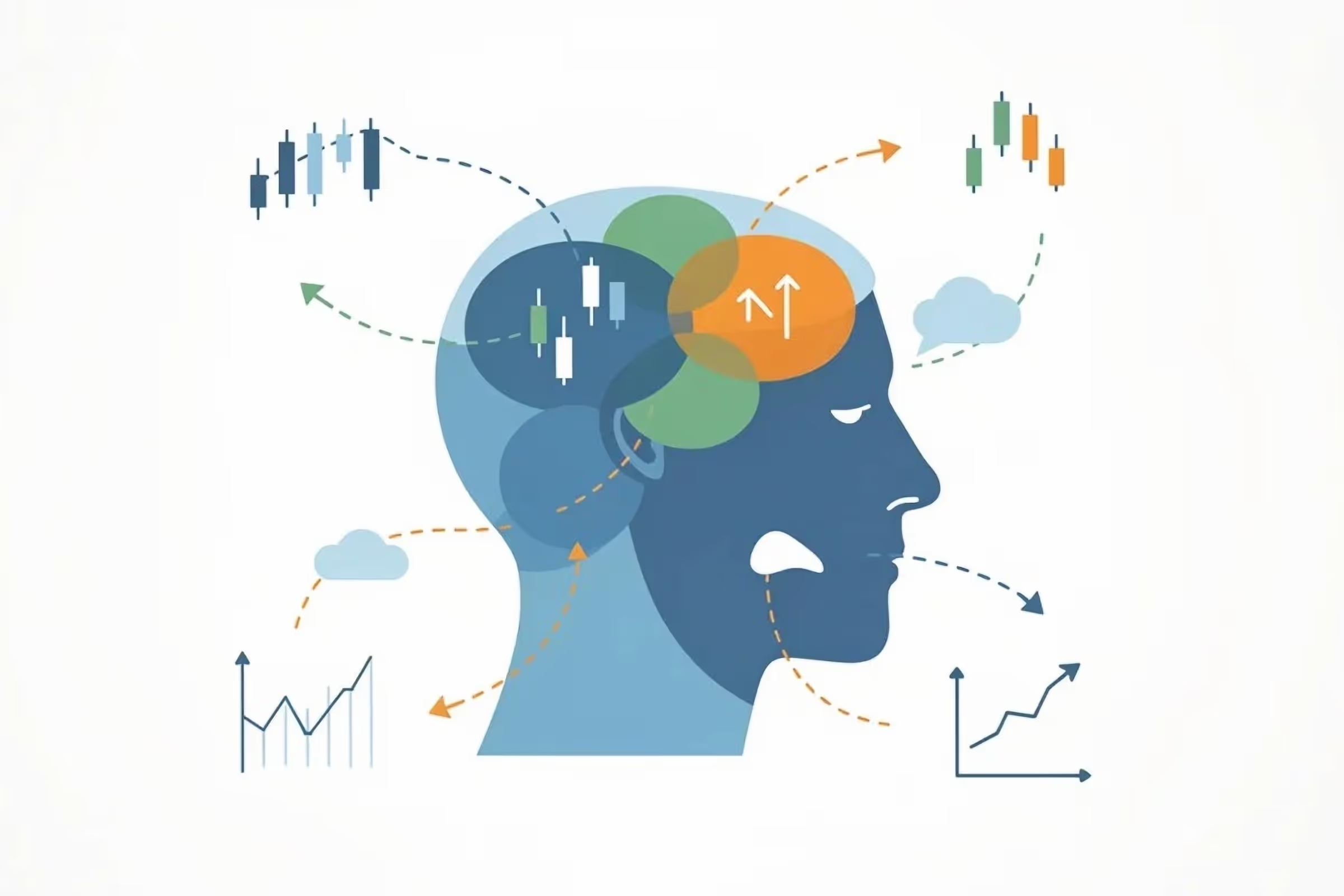
The Role of Uncertainty in Financial Markets

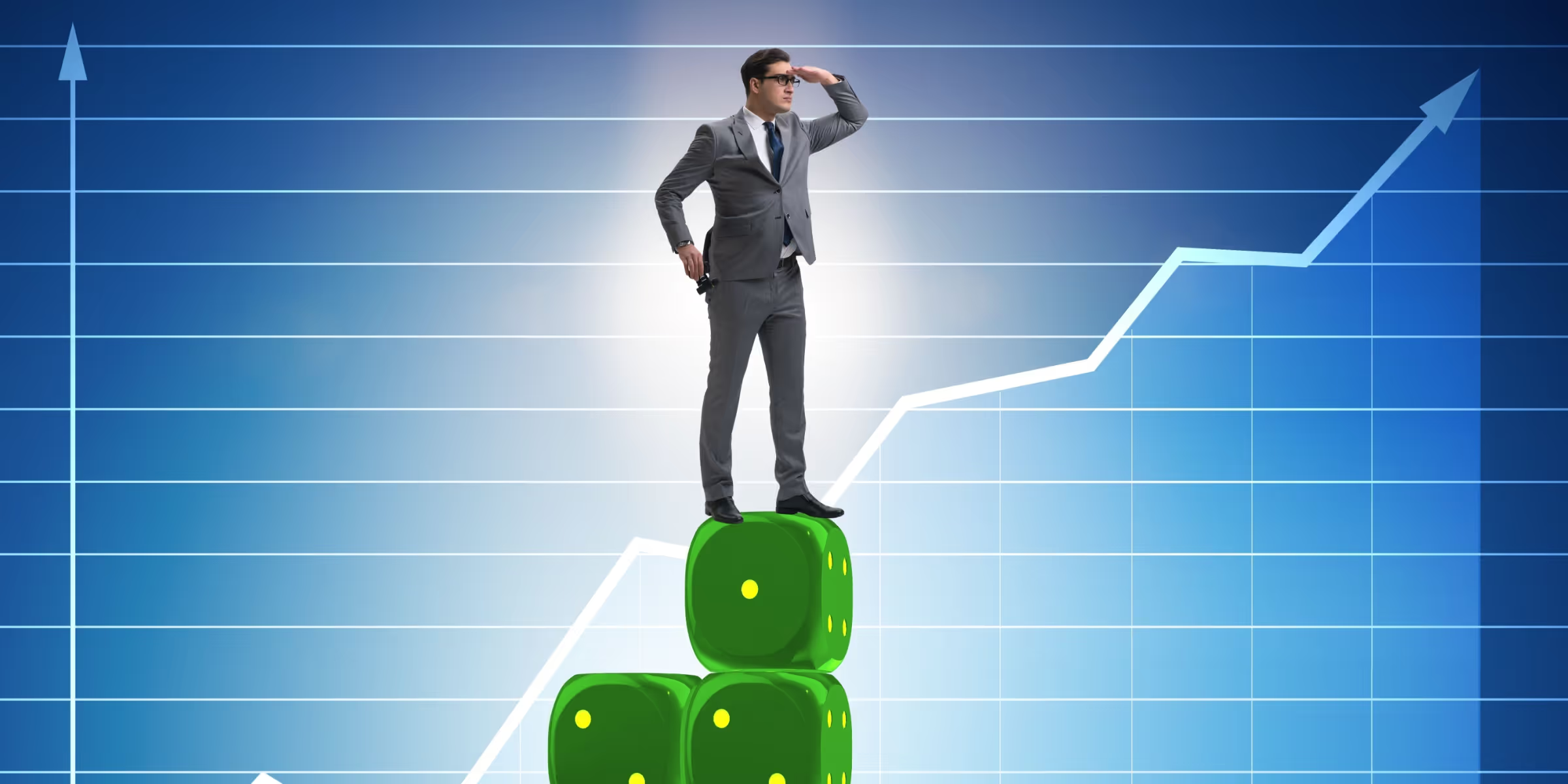
Uncertainty is an inherent part of trading
Understanding whether trading is truly a form of gambling requires a closer look at the type of risks involved in financial markets. Every transaction made in the markets is ultimately a decision made under uncertainty. No trader can predict the future with complete accuracy. Unless someone is trading based on insider information, which unfortunately does exist in financial markets, every market participant must make decisions without knowing exactly what will happen next.
This uncertainty is the fundamental characteristic that often leads people to compare trading with gambling. However, while uncertainty is present in both activities, the way it is approached can be very different.
When traders enter a position in the market, they rely on available information to make the best possible decision. This information may include technical analysis, fundamental economic data, market sentiment, and historical price behavior. Traders study charts, analyze economic reports, and examine how prices reacted in the past under similar conditions.
Even with thorough analysis, there is no guarantee that a trade will succeed. In fact, losing trades are a normal and unavoidable part of trading. Because of this uncertainty, successful traders do not rely on certainty; they rely on probability.
In many ways, trading resembles the decision-making process of a professional poker player. A skilled poker player does not expect to win every hand. Instead, they assess the situation, calculate the odds, and make decisions that give them the highest probability of success over time. Professional traders approach the market in a similar way by analyzing past price movements and identifying patterns that may provide a statistical advantage.
Markets often exhibit recurring behaviors. Prices tend to react around certain levels, revisit previous zones, and form recognizable patterns. By studying these patterns and understanding how price behaves, traders can increase their chances of being on the correct side of the market. However, even the best analysis cannot eliminate uncertainty.
Why markets are naturally unpredictable
Financial markets are complex systems made up of millions of participants, each with different goals, strategies, and levels of information. Institutional investors, hedge funds, retail traders, corporations, and governments all interact within the same market environment. Because of this diversity, price movements are influenced by a wide range of factors.
At times, markets can behave in a very chaotic way. During periods of fear or financial panic, large groups of investors may rush to sell their positions simultaneously. This can lead to sharp declines in prices and extreme volatility. In such moments, even fundamentally strong and profitable companies may see their stock prices collapse simply because confidence in the market disappears.
This demonstrates an important truth about markets: nothing is guaranteed. Prices move based on the balance between confidence and fear among participants. When confidence dominates, markets rise. When fear takes over, markets can fall rapidly.
Because of this environment, trading always involves a degree of uncertainty. In that sense, trading does contain elements that resemble gambling. However, it can also be described as calculated risk-taking, where informed decisions are made using analysis, probability, and experience.
When trading turns into gambling

While disciplined trading relies on probability and risk management, trading can easily turn into pure gambling when individuals participate without proper knowledge or preparation.
A trader who enters the market without a plan, without understanding risk, and without controlling emotions is essentially guessing. In this situation, trading becomes very similar to gambling on a casino floor. Decisions are driven by excitement, hope, or desperation rather than by analysis and strategy.
The danger is even greater because financial markets provide access to leveraged instruments such as futures, options, and margin trading. Leverage allows traders to control large positions with relatively small amounts of capital. While leverage can increase profits when used responsibly, it can also magnify losses dramatically.
In some cases, a single poorly managed trade can wipe out an entire trading account within minutes.
Why risk control is entirely the trader’s responsibility
One major difference between casinos and financial markets is the structure of the environment. In a casino, games operate within defined rules and limits. Each round of a game ends within a set time, and players’ participation can be controlled by the dealers.
In trading, however, there is no dealer controlling the pace of the game. The trader alone is responsible for managing risk and deciding when to exit a losing position. If a trader refuses to accept a loss and hopes that the market will eventually turn around, the situation can quickly become dangerous.
Many traders lose large amounts of money because they refuse to admit they were wrong. Instead of closing a losing trade and protecting their capital, they hold onto it while hoping the market will reverse in their favor.
Ironically, trading without discipline can sometimes be more dangerous than gambling in a casino. Losses in financial markets can become extremely large if risk is not properly controlled.
Calculated risk vs pure chance
So, is trading gambling?
In a strict sense, trading does involve risk and uncertainty, which are characteristics commonly associated with gambling. However, there is a critical difference. Professional traders approach the markets using analysis, probability, and disciplined risk management. Their goal is not to win every trade but to develop a statistical edge that produces profits over time.
When trading is approached with knowledge, experience, and structured risk control, it becomes a form of calculated risk-taking rather than blind gambling.
But when people enter the markets without preparation, trade emotionally, and rely on luck rather than strategy, trading becomes exactly what many critics claim it is - gambling.
Understanding this distinction is essential for anyone who wants to participate in financial markets responsibly.
Topics
Trading Myths

Beginner Trading
Technical Analysis
Market Education
Risk Management