Why 90% of Traders Fail? It's Not What You Think


What does “failing” really mean in trading?
When people think about failure in trading, they usually imagine the worst-case scenario: a blown account, devastating emotional stress, the loss of savings, or even bankruptcy. In many ways, this is the most visible and dramatic form of failure, especially for those who pursue trading or investing as a career.
But there is another type of failure that most people don’t recognize. Before traders ever lose their capital, they usually fail first by not developing consistency. The inability to build structure, discipline, and repeatable execution is the real beginning of failure. It’s not just about losing money. It’s about never developing a stable process that can produce predictable results over time.
This lack of consistency is what leads to emotional decisions, strategy-hopping, overtrading, and abandoning plans at the first sign of difficulty. It creates frustration and confusion, which eventually leads to financial loss.
Why 90% of traders fail: they chase profits instead of the process
You often hear the claim that 90% of traders fail. However, what truly matters is not whether the correct number is 80% or 90%, but rather what it indicates. What matters is understanding why the majority struggle and eventually fail to achieve long-term success.
Why does this happen? The answer is simple. Most people focus on profits instead of process. They think in terms of gaining quick money, large returns, and financial freedom right away. They don't approach trading in terms of structure, risk management, journaling, discipline, and consistency. Without these foundations in place, even the best strategy is likely to fail.
Trading success is not built on excitement or occasional big wins. It is built on consistency, structure, and the ability to execute a plan repeatedly without emotional interference.
Execution over information: the mindset that separates winners
One of my mentors, who taught me years ago how to approach this business properly, told me something I have never forgotten. He said, “In trading, 10% is knowledge and 90% is psychology.” In other words, you can read every book, study every strategy, and consume endless educational material, but if you cannot execute properly, none of it matters.
Knowledge alone does not produce profits. Execution does. You may learn risk management, technical analysis, market structure, and trading systems. But if fear makes you close trades too early, greed makes you change your plans on the go, or frustration leads you to overtrade, your knowledge becomes useless.
Trading success is not determined by how much you know. It is determined by how well you can control your emotions, follow your plan, and remain disciplined under pressure. The real edge in trading is not just information or knowledge. It is the psychological ability to manage your emotions and stick to your plan, no matter how difficult the situation becomes.
Does this mean that you don’t need trading education?

Absolutely not. Education is the first essential step. Without it, there is no foundation for building a solid trading system. You cannot develop psychological discipline if you don’t even understand what skills need to be improved or what mistakes you’re making.
Ironically, most traders skip this stage entirely. They jump straight into the markets, relying on media headlines, social media tips, or other people’s opinions, believing that quick information will lead to quick success. But trading is not a business built on someone else’s ideas. It is a performance-based profession that requires you to develop your own structured approach. Every trader is different. Risk tolerance, emotional control, patience, and even personality traits vary from person to person. You cannot simply copy someone else’s strategy and expect identical results. If it were that easy, everyone would be profitable.
The first step is always proper education. Once you understand market structure, risk management, and trading mechanics, you can begin progressing based on your unique situation. Start small. Test yourself. Identify your weaknesses. Build a strategy that aligns with your personality and your ability to handle stress and uncertainty.
If more traders respected this step, far fewer accounts would be blown. When someone loses money without understanding what they’re doing, the experience is often so painful that they never return to trading. I’ve seen many people either quit permanently after heavy losses or finally decide to educate themselves properly before trying again.
Education alone doesn’t guarantee success. But without it, failure is almost certain.
The Danger of Unrealistic Expectations in Trading
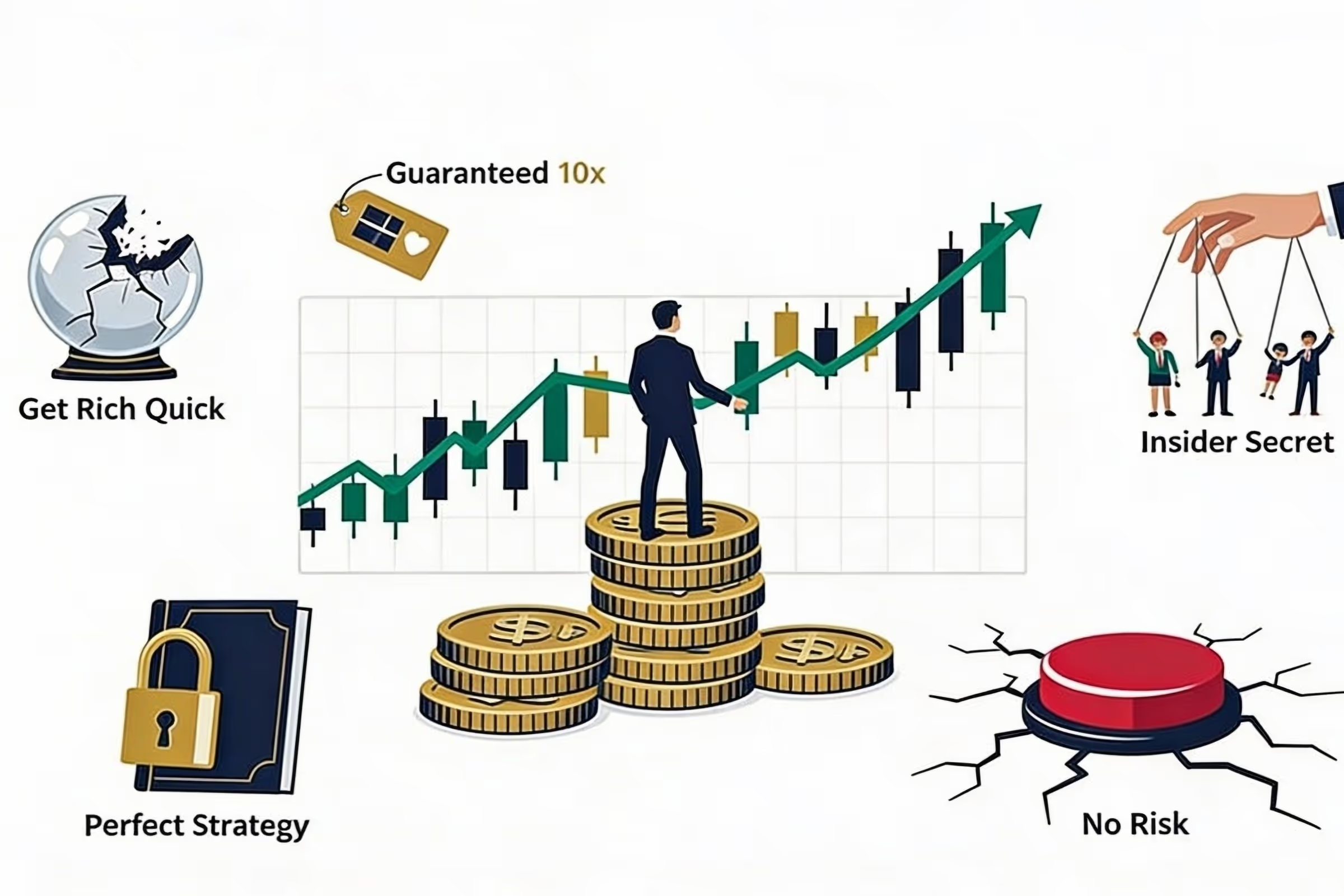
One of the biggest mistakes beginner traders make is setting unrealistic financial expectations from the start. Their primary goal is often to turn a small amount of capital into a large sum in a very short period of time. For example, someone might attempt to turn $500 into $10,000 as quickly as possible.
Can this happen? Yes. In financial markets, almost anything is possible. There are countless stories of individuals who experienced massive returns. Think about cryptocurrency. If someone had purchased Bitcoin at $10 or $50 and held it until it reached six figures, the returns would have been extraordinary.
But here is the critical question: What were the chances of that happening to you specifically - especially without knowledge, research, or a clear understanding of the risks involved? The probability is extremely low.
Massive returns typically come with massive risk. The individuals who achieve exceptional gains often have deep market knowledge, significant experience, or a strong understanding that they could lose their entire investment. They accept the risk consciously.
This is where many beginners go wrong. They focus on extraordinary outcomes without fully understanding the level of risk required to achieve them. To generate explosive returns, you usually need to take equally explosive risks. That “boom or bust” approach is not how professional traders operate.
Professional traders manage expectations carefully. They base decisions on probability, structured systems, and strict risk-to-reward calculations. They focus on preserving capital first and growing it steadily over time. Their goal is consistency—not lottery-style wins.
Retail traders operate with limited capital. We cannot compete with large investment banks or institutional firms that have vast resources and sophisticated risk models. Because of this, our approach must be different. We must prioritize risk control, realistic expectations, and disciplined execution.
Blowing up an account usually happens when expectations are disconnected from reality. Strict risk management, controlled position sizing, and proven trading systems are essential for long-term survival.
This is where proper education becomes invaluable. Education helps traders understand probability, risk exposure, and how to build strategies aligned with realistic goals. It shifts the mindset from chasing extraordinary gains to building sustainable performance.
In trading, long-term success is not built on extraordinary returns. It is built on disciplined risk management, realistic expectations, and consistent execution over time - an approach that leads to steady, calculated, and more predictable profits.
Risk Control: The Skill That Keeps Traders in the Game

Another reason most traders fail is poor risk management or the complete absence of it. Emotional decision-making around risk is extremely common in the trading world. You have probably heard people say that trading is only for geniuses or for those who already have a lot of money. According to this belief, the average person with a regular job and standard education cannot succeed.
This idea is not only incorrect but also dangerous. It pushes inexperienced traders to blindly follow advice from strangers online, often leading to losses or even scams. The truth is much simpler: success in trading has far less to do with intelligence or starting capital and far more to do with properly managing risk.
There is no perfect trading system that works in every market condition. Markets are made up of many participants, including institutions, algorithms, retail traders, and hedge funds, all acting for different reasons. Because of this complexity, no strategy can predict the future with certainty. The market will do what it will do.
Professional traders understand this reality. That is why they approach trading from a probability-based perspective. They prepare for multiple outcomes and accept that losses are part of the business. Most importantly, they are always prepared for the possibility that a trade may go wrong.
This is where risk management becomes critical. It is the only element in trading that you can fully control. You cannot control price movement, news events, or market sentiment. But you can control position size, stop-loss placement, and how much capital you are willing to risk on a single trade.
Beginners often ignore this principle. Without a structured plan, they risk too much on one idea, hoping for a quick win. When the trade moves against them, emotions take over. The result is often a significant financial loss or, in some cases, a total account blowout.
In fact, poor risk management almost always leads to the same outcome: blown accounts and frustration. That is why capital preservation must come before profit generation. If you cannot protect your capital, you will not survive long enough to become consistently profitable.
This has nothing to do with how smart you are or how much money you start with. In fact, highly intelligent individuals sometimes struggle even more because their ego gets in the way. The market has a way of humbling everyone. Personal opinions do not move price. The market does not care what you think—it will move according to supply and demand.
Many traders only realize this after experiencing painful losses. Accepting that control comes from risk management, not prediction or hope, allows you to align with the markets more quickly.
Proper and disciplined risk management keeps you in sync with the market. It allows you to survive losing trades, stay objective, and continue operating without emotional collapse.
In the upcoming course, I will explain in detail what risk management means and show you how to build a structured plan tailored to your unique situation, personality, and risk tolerance.
Topics
Trading Myths

Beginner Trading
Technical Analysis
Market Education

Risk Management