Understanding Gambling, Risk, and Human Behavior


Gambling and risk are often confused
Many people consider gambling to be inherently bad. This perception usually comes from personal experiences of losing money or from hearing stories about friends or relatives who suffered financial losses. In most cases, the negative view of gambling comes from situations where people place bets or take large risks in hopes of winning big money to solve financial problems.
However, if we look more closely at our daily lives, we realize that gambling, or more accurately, taking risks under uncertainty, is something we do all the time. Every decision we make involves some level of uncertainty about the future. When we choose a particular path, we are essentially placing a bet that the outcome will bring us happiness, progress, or improvement in our lives.
Consider something as simple as planning a vacation. If the planning is poor or important factors are overlooked, the trip may turn into a disappointing experience rather than an enjoyable one. In a sense, this is also a form of gambling—we make decisions without knowing the final outcome with certainty.
Financial decisions provide even clearer examples. Buying an expensive car with a high interest rate can be seen as a gamble. The purchase may bring satisfaction and enjoyment, or it may create financial stress for years to come. Another example is choosing to attend an expensive private college with the hope that it will lead to better career opportunities in the future. Alternatively, someone might attend a community college first and later transfer to a university, saving a significant amount of money. In both cases, the individual is making a decision today based on expectations about the future, without knowing the exact outcome.
How society views gambling
Despite the fact that risk and uncertainty are present in many areas of life, the word gambling is often strongly associated with casinos, sports betting, and other forms of wagering money. While it is true that most people who gamble in casinos lose money over time, there are also professional gamblers who make a living through disciplined strategies and statistical advantage. For some individuals, gambling becomes a career. For others, it is a desperate attempt to solve financial problems. And for many people, it is simply a form of entertainment that adds excitement to their leisure time.
When we consider all of these perspectives, it becomes clear that gambling itself is not inherently bad. The decisions we make, the risks we take, and even the mistakes we experience are all part of the learning process that shapes who we become. Some people grow stronger and wiser after failures, while others, unfortunately, repeat the same mistakes.
The role of human psychology
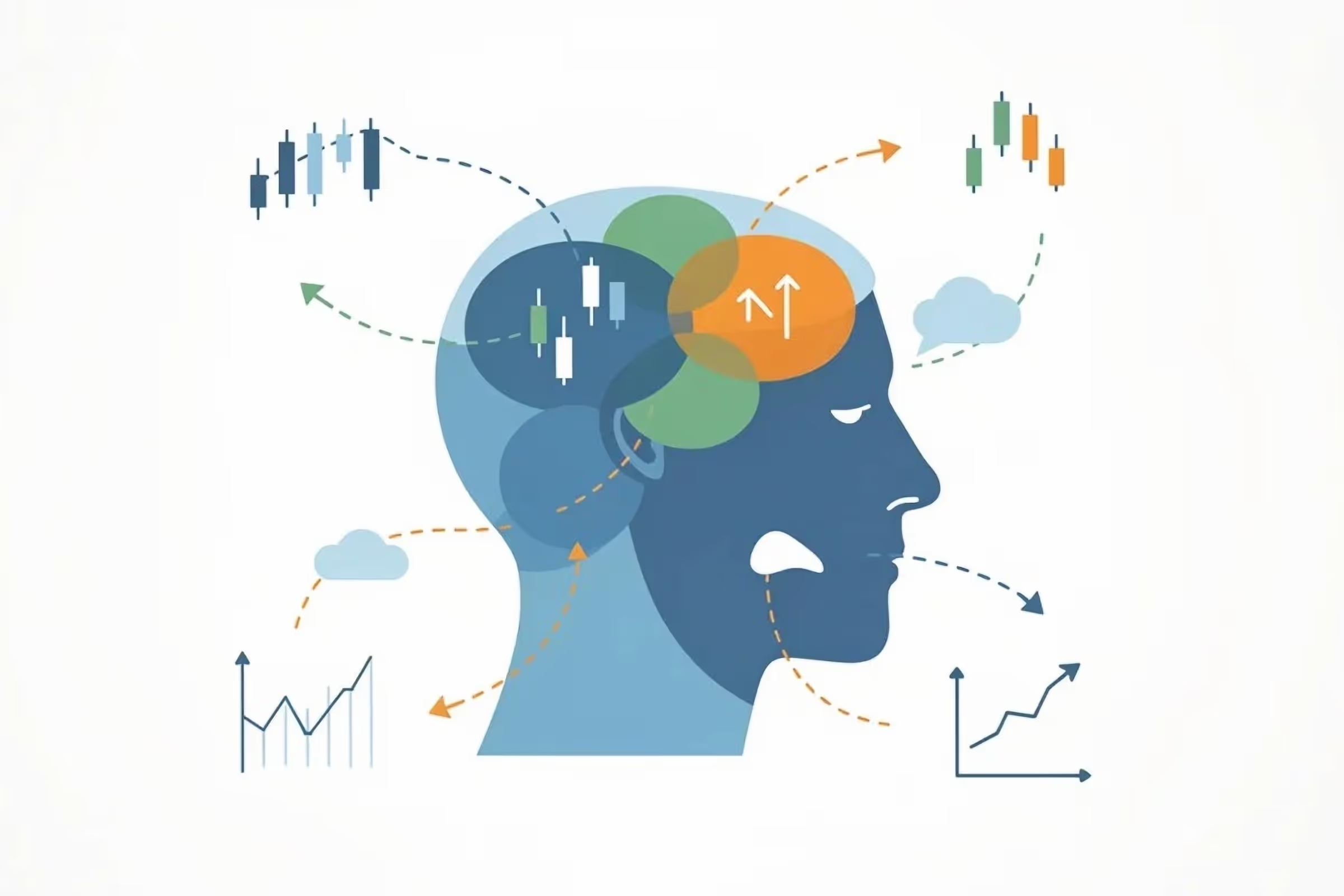
The real problem arises when people fail to properly assess the risks involved or when their psychological state leads them to become addicted to the excitement of gambling. In many cases, the path to financial ruin is not caused by gambling alone but by human psychology. People often struggle to accept losses and may attempt to recover them through even riskier decisions. Instead of learning from failure, they sometimes try to prove that they can overcome a bad situation through luck.
Our brains are naturally drawn to moments of excitement and reward, such as winning money or experiencing sudden success. Once these feelings are experienced, the brain craves them again and again. Casinos understand this aspect of human psychology extremely well. Their entire business model is designed around it. Even though the mathematical odds are usually unfavorable for players, people continue to gamble in hopes of hitting a jackpot.
Managing risk responsibly
Yet despite all of this, risk-taking itself should not be viewed purely as a negative behavior. When approached with awareness and proper evaluation of risks, it can be a powerful tool for growth and progress. The key is to make rational decisions based on probabilities rather than relying on hope or luck.
In other words, gambling becomes harmful not because uncertainty exists, but because people fail to manage it responsibly. When we learn to evaluate risks carefully and avoid the illusion that luck alone will solve our problems, uncertainty becomes something that can help us grow rather than destroy us.
Topics
Trading Myths

Beginner Trading

Technical Analysis
Market Education

Risk Management