Demo Accounts for Beginners: Pros and Cons

Should Beginners Use a Demo Trading Account? The Truth About Paper Trading
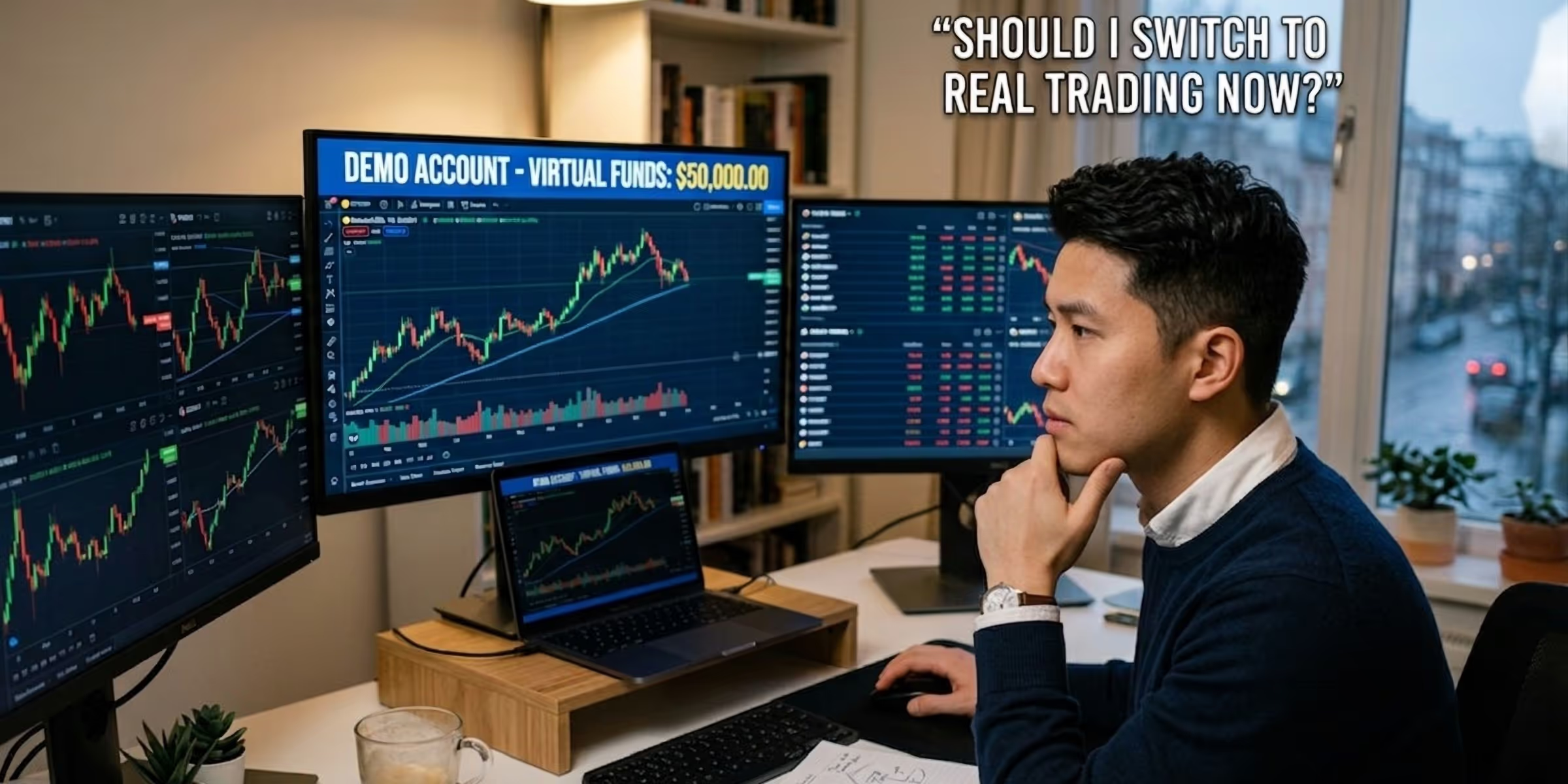
Many experienced traders strongly recommend that beginners start their trading journey with a demo account. Almost every brokerage platform today offers some form of paper trading account, allowing users to trade with simulated money while using the exact same tools and platform features that professional traders use every day. For someone who is completely new to trading, this can be an incredibly useful learning environment. It allows beginners to become familiar with placing orders, understanding different types of trades, navigating the trading platform, and observing how markets move — all without risking real money.
At first glance, paper trading seems like the perfect solution. After all, if you can practice trading without losing actual money, what could possibly be the downside? For beginners, demo accounts appear to offer a safe and risk-free way to build confidence before committing real capital.
However, the reality is a bit more nuanced.
While demo trading can be a valuable educational tool, it also has important limitations that many beginners overlook. In fact, relying on a demo account for too long can sometimes create habits or expectations that don’t translate well into real market conditions. Trading with simulated money simply does not replicate the emotional pressure, psychological stress, and decision-making challenges that come with risking real capital.
This raises an important question for new traders: Should you start with a demo account at all, or is it better to begin trading with real money right away? And if demo trading is useful, how long should a trader stay in simulation before transitioning to real trading?
In this article, we will explore both sides of this topic by examining the key advantages and disadvantages of paper trading. You will see why demo trading can be extremely helpful at the very beginning of your trading education, but also why it is important not to rely on it for too long.
More importantly, we will discuss why transitioning to real trading relatively quickly is a critical step in a trader’s development. Without experiencing the psychological and emotional realities of trading real money, it is nearly impossible to develop the skills essential for long-term success in the markets.
Let’s begin by looking at some of the most important advantages that paper trading provides to new traders.
Advantages:

Learning the Trading Platform
One of the first major challenges every new trader encounters is learning how to effectively use the brokerage platform they have chosen.
While this might seem straightforward at first, most modern trading platforms are highly sophisticated and packed with tools and features. Depending on the brokerage, these platforms often include advanced order types, charting systems, risk management tools, market scanners, and analytical indicators.
For someone completely new to trading, navigating all of these features can feel overwhelming. Even experienced traders sometimes need time to adapt when switching to a new platform because each brokerage has its own layout, tools, and execution methods. For beginners, this learning curve can be quite steep. This is exactly why using a paper trading account in the beginning is highly advisable.
A demo account provides a safe environment where traders can explore the platform and learn its features without the pressure of risking real money.
Learn Without Losing Money
One of the biggest advantages of paper trading is the ability to learn trading without losing money. In the early stages of trading, mistakes are inevitable. Beginners may misunderstand how orders work, misread the market, or execute trades incorrectly.
With a demo account, these mistakes do not come with financial consequences. Instead of losing money, each mistake becomes a valuable lesson. This allows new traders to gain experience and confidence while protecting their capital.
Understanding Market Mechanics
Another important benefit of paper trading is the opportunity to understand how the market actually works. Beginners can observe how prices move, how supply and demand influence the market, and how volatility changes during different trading sessions.
Watching these dynamics unfold in real time helps traders develop a deeper understanding of market behavior, something that cannot be fully learned through theory alone.
Testing Trading Strategies
Paper trading also allows beginners to test their initial trading strategies. Many new traders start with ideas about how they want to approach the market, but those ideas need to be tested before real money is at stake.
A demo account provides the perfect environment to experiment with different setups, entry points, and risk management techniques. Traders can evaluate what works and what doesn’t without risking their capital.
Understanding Order Execution
Another critical skill that traders can develop through paper trading is learning how orders are executed. Beginners can practice placing market orders, limit orders, stop orders, and other order types while observing how those orders behave in real market conditions.
Becoming comfortable with order execution is essential because mistakes in order placement can become very costly when trading with real money.
Practicing Trade Management
Paper trading also provides an excellent opportunity to practice managing trades. This includes learning how to monitor open positions, adjust stop-loss levels, scale in or out of trades, and decide when to take profits.
These are practical skills that every successful trader must develop. Practicing them in a risk-free environment helps build discipline and confidence before transitioning to real trading.
A Risk-Free Training Environment
Ultimately, the greatest advantage of paper trading is that it provides a completely risk-free environment for learning and experimentation. Beginners can explore the trading platform, test ideas, and develop their skills without worrying about losing money.
For these reasons, I strongly believe that beginner traders should absolutely start with a paper trading account. It serves as the perfect training ground to learn the platform, understand market mechanics, test strategies, practice order execution, and develop trade management skills before moving on to real trading.
Disadvantages:

Why Traders Must Eventually Transition to Live Trading
While paper trading is extremely helpful at the beginning of a trader’s journey, there comes a point when continuing to rely on a demo account can actually slow down your development. This happens because many of the most important skills required for successful trading cannot be learned in a simulated environment.
Trading is not only about strategies, technical analysis, or understanding the platform. A large part of trading success depends on psychological skills, such as risk management, emotional control, and rational decision-making under pressure. These skills only begin to develop when real money is involved.
Many traders fail not because they lack knowledge about the markets, but because they never develop the emotional and psychological discipline required to trade consistently. Paper trading simply cannot replicate the real pressure of risking your own capital.
Below are some of the major limitations of demo trading and why transitioning to live trading quickly becomes essential to a trader’s development.
Limited Experience in Managing Risks with a Demo Account
One of the biggest shortcomings of paper trading is that it does not teach traders how to deal with real financial losses. In a demo account, losses are simply numbers on a screen. When a trade goes wrong, the trader does not feel the financial impact.
However, in live trading, losses carry real consequences. Losing money creates emotional discomfort and forces traders to confront the reality of risk. Learning how to accept losses, manage risk properly, and continue trading with discipline after a losing trade is one of the most important skills a trader should develop. Unfortunately, this skill cannot be fully learned in a paper trading environment.
No Development of Emotional Stress Management
Trading with real money introduces a level of emotional pressure that paper trading cannot replicate. Fear, greed, hesitation, and anxiety often appear when real capital is on the line.
In a demo account, traders may feel completely calm while making decisions because nothing meaningful is at risk. But once real money is involved, even small trades can trigger strong emotional reactions.
Learning to manage this emotional stress while still making logical decisions is a skill that only develops through live trading experience.
Overconfidence From Unrealistic Results
Another common issue with paper trading is that it can create overconfidence. Because there is no emotional pressure and no real financial risk, traders often take trades that they would never take in live trading.
As a result, many traders achieve impressive results in demo accounts. However, these results are often misleading because they do not reflect the psychological challenges that appear when trading real money. When traders eventually switch to live trading, they may discover that their performance changes dramatically.
Order Execution Is Not Always Realistic
Paper trading also often fails to fully replicate real-world order execution. In live markets, factors such as liquidity, slippage, and market volatility can affect how orders are filled.
In many demo environments, orders are filled instantly and perfectly, which creates a simplified version of trading that may not match real market conditions. This can lead traders to believe that execution will always occur exactly as planned, which is not always the case in live trading.
Creates False Expectations
Because of these differences, paper trading can sometimes create false expectations about how trading actually works. Traders may believe that achieving consistent profits is easier than it really is.
When they eventually begin trading with real money, the emotional pressure and market realities can come as a shock. This gap between expectations and reality is one reason many traders struggle when transitioning from demo accounts to live trading.
Does Not Promote Discipline
Another reason to transition to live trading as soon as possible is that paper trading does not fully develop trading discipline. Discipline in trading often comes from recognizing the consequences of poor decisions.
When real money is at stake, traders are compelled to adhere to their rules, manage risk carefully, and control impulsive behavior. In a demo account, violating rules carries no real cost, which makes it easier to develop bad habits.
Real discipline typically develops only when traders experience the actual financial outcomes of their actions.
For these reasons, while paper trading offers many benefits in the early stages of learning, it also has important limitations that every trader must eventually overcome.
Demo trading is an excellent starting point for beginners, as it allows traders to familiarize themselves with the platform, understand market mechanics, and test strategies without risking real money. However, it's important to view paper trading as just the first step in the learning process, rather than the final destination. To develop the psychological discipline, emotional control, and risk-management skills necessary for long-term success, traders must eventually transition to live trading, where real money is at stake, and the consequences are real.
Topics
Trading Myths

Beginner Trading
Technical Analysis
Market Education

Risk Management