The Risks of Following Random Trading Advice

When Trading Advice Can Actually Be Helpful:
Learning from experienced traders and reputable educational sources
If you are new to trading, the most important step you can take is to focus on education before risking real money in the markets. Many beginners feel tempted to jump straight into trading and try to make quick profits, but this approach often leads to unnecessary losses. A much smarter path is to first invest time in understanding how financial markets operate and how trading actually works.
Understanding the fundamentals of trading can significantly shorten your learning curve and help you avoid many of the costly mistakes that beginners commonly make. Unfortunately, this is the step that many new traders skip, and it often ends up costing them both time and capital.
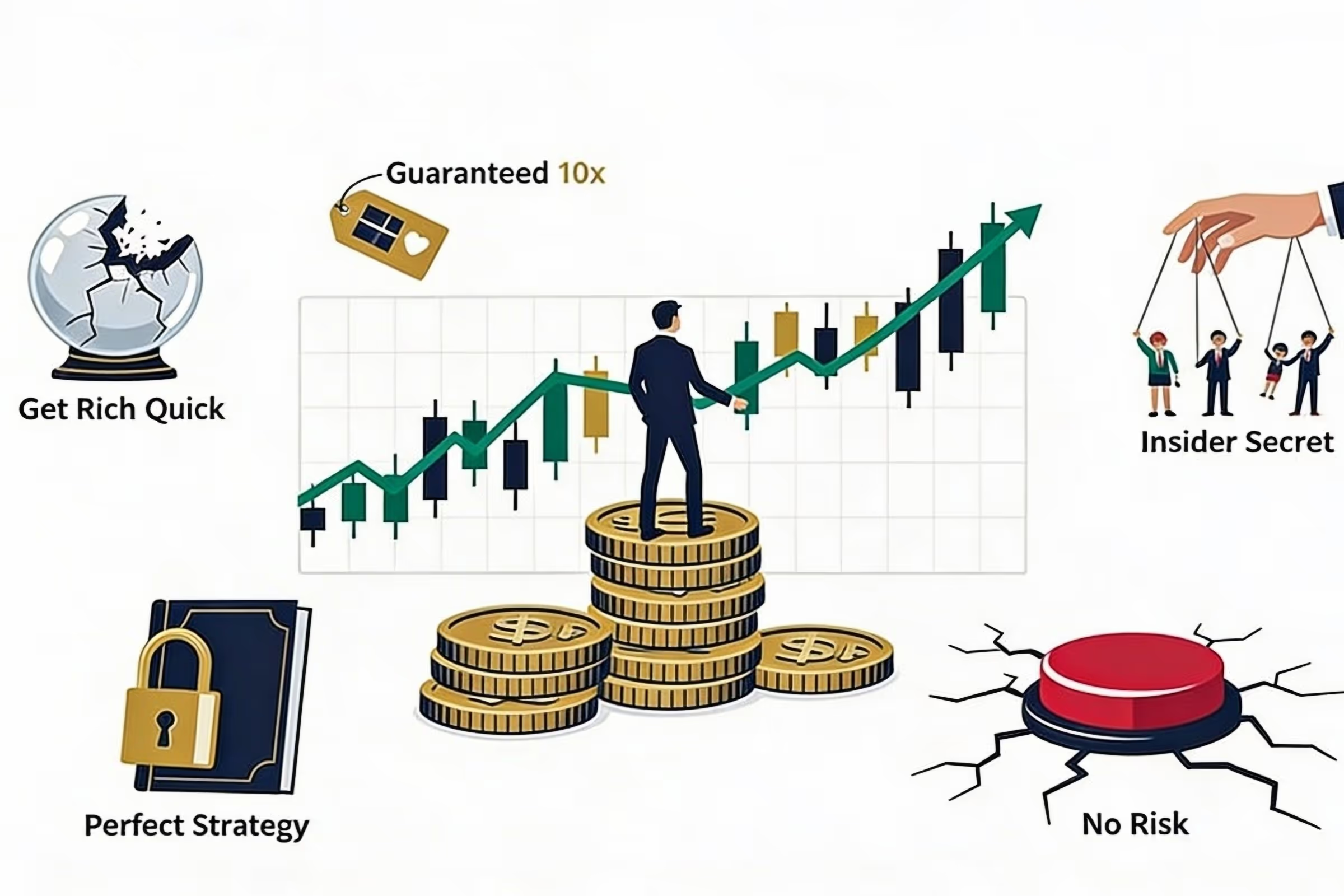
The challenge, however, is figuring out where to get reliable information. The internet is full of people promising trading systems that supposedly generate large profits quickly and effortlessly. These types of claims should always be approached with caution. In most cases, anything that promises fast results and easy profits is either exaggerated or simply unrealistic.
Instead, it is better to take a more thoughtful approach. Spend time researching the basics of financial markets on your own or through reputable educational sources before deciding whether you want to invest in a course, read specialized books, or learn from experienced traders who have a proven understanding of the markets.
One of the strongest indicators that someone may provide valuable education is honesty about the difficulty of trading. When a teacher or mentor explains that trading takes time to learn, requires discipline, and involves many different factors, that is usually a good sign that they are presenting the subject realistically.
It is also important to understand that quality education rarely comes completely free. If you are serious about learning how to trade, you will likely need to invest some money in books, courses, or mentorship from experienced professionals. This should be viewed not as a cost, but as an investment in building the skills necessary to approach trading responsibly.
Even professional traders continue learning throughout their careers. Markets evolve, conditions change, and strategies must adapt over time. There is no perfect system that works in every market environment, which is one reason trading can be so challenging at the beginning.
The key for beginners is to focus on building a strong foundation of knowledge first. Without proper education, there is a high probability that early losses will discourage you before you ever have the chance to develop real skill. After all, humans tend to avoid situations that cause repeated losses or stress, especially when money is involved.
By prioritizing education and learning from credible sources, you give yourself a much better chance of navigating the difficult early stages of trading and moving forward with a clearer path in your trading journey.
The Hidden Problems With Random Trading Advice:

Advice from people who do not trade their own strategies
The internet is filled with individuals who attempt to sell trading strategies in hopes of generating income. In many cases, these strategies are aggressively marketed to beginners eager to find a quick solution to start making money in the markets. Unfortunately, some of the people selling these strategies do not actually use them themselves.
This does not necessarily mean that every strategy being sold is completely ineffective. In some cases, the seller may have developed a strategy with potential but lacked the patience, discipline, or psychological resilience to follow it consistently. Instead of continuing to test and improve it, they may decide to sell the system to recoup the time and effort they invested in developing it.
However, even if a strategy has some merit, there is no guarantee that it will fit your personal situation. Every trader has a different tolerance for risk, emotional responses to losses, and patience. A strategy that works for one trader may be extremely difficult for another to follow consistently.
This is why developing your own approach through learning, testing, and experience is so important. Only by experimenting with different methods can you eventually discover a strategy that aligns with your personality, emotional tolerance, and decision-making style.
Untested strategies presented as proven methods
Another common issue in the online trading space is the promotion of strategies that have never been properly tested. With so much trading information available on the internet, it is relatively easy for someone to gather ideas from different sources, combine them into a single “system,” and present it as an original trading strategy.
In many cases, the person selling the strategy has never tested it extensively in real market conditions. Without proper testing, it is impossible to know how the strategy performs across different market environments or how it behaves during losing streaks.
A reliable trading strategy should be tested over a meaningful number of trades so that its strengths and weaknesses become clear. Traders typically evaluate their strategies by executing and documenting multiple trades, reviewing the results, and adjusting their approach based on the data they collect.
Testing strategies under real market conditions, journaling trades, and analyzing performance over time are among the most reliable ways to determine whether a strategy truly works. This structured testing process is explained in much greater detail in my upcoming course.
The key takeaway is simple: every strategy must prove itself through testing before it can be trusted.
Selling products without accountability for results
Another major problem with random trading advice is the lack of accountability. When you learn from a professional trader or a reputable educational source, there is usually ongoing guidance and explanation behind the trades being made. An experienced mentor can review trades with you and help you understand why a particular decision worked or failed.
However, many people who sell trading systems or signals online have a very different objective. Their goal is often simply to sell the product. Once the transaction is completed, what happens afterward is rarely their concern.
A useful comparison can be made with purchasing a product such as a car. If the car develops problems after purchase, you may receive help only if a warranty is in effect. Otherwise, the responsibility falls entirely on you.
A similar situation can occur when purchasing trading systems. A strategy might be advertised as highly profitable, but when it fails to produce the expected results, the buyer is often left without support or recourse.
The truth is that no trading strategy can guarantee success, and anyone who claims otherwise should be approached with caution. Trading is a demanding profession that requires continuous learning, discipline, and personal responsibility.
Exaggerated profit claims and misleading performance
One of the most common warning signs in the trading industry is the promise of guaranteed profits or consistently high returns regardless of market conditions. These claims are extremely attractive to beginners who are eager to find a strategy that removes uncertainty from trading.
Some individuals even attempt to support their claims by showing screenshots or statements from trading accounts that appear to demonstrate impressive profits. However, these types of displays can sometimes be misleading.
For example, it is technically possible to open multiple trading accounts and take opposite positions in the same asset. If one position loses money, the other may show a profit. By selectively displaying only the profitable account, it becomes easy to create the illusion of consistent success.
Situations like this do occur online, which is why traders must remain cautious when evaluating performance claims. The reality is that no strategy produces profits in every situation, and any claim suggesting guaranteed results should immediately raise concerns.
Strategies that fail over the long term
Another challenge with blindly following trading advice is that many strategies appear to work well only during certain market conditions. Financial markets move in cycles. Sometimes markets trend upward for extended periods, while at other times they experience prolonged declines or sideways movement.
During strong bullish periods, it may seem as though almost any strategy works. Simply buying stocks or market index funds during these periods can produce impressive returns. Some online personalities take advantage of these favorable conditions and present simple “buy everything” approaches as if they were foolproof systems.
The problem arises when market conditions change. Once a bullish cycle ends and markets begin to decline, strategies that relied entirely on rising prices can fail quickly. Traders who rely on those strategies without understanding market cycles may suddenly experience significant losses.
This is why it is important to understand that no single strategy works in every market environment. Professional traders often adapt their strategies based on changing market conditions and develop multiple approaches that perform well in different situations.
Education, experience, and continuous testing are essential for learning when a particular strategy should be applied and when it should be avoided.
The reality: valuable trading knowledge is hard to obtain and often expensive, but it can still be found in the right place
Like many things in life, the quality of the information you receive often reflects the effort and resources invested in obtaining it. This principle is especially true when it comes to trading education.
High-quality knowledge typically comes from individuals who have spent years studying markets, testing strategies, and learning from both successes and failures. Naturally, this type of experience is valuable and is not always freely available.
This does not mean that trustworthy education is impossible to find. It simply means that traders must approach the search for knowledge carefully. Doing your own research, evaluating the credibility of sources, and developing a basic understanding of how markets work will help you distinguish valuable information from misleading claims.
Once you develop this foundational knowledge, it becomes much easier to filter out unreliable strategies and focus on ideas that are supported by logic, experience, and real market evidence.
Through the educational content on this website and in my upcoming course, my goal is to help you build that foundation and learn how to recognize the difference between speculation and genuinely useful trading knowledge.
The Negative Consequences of Following Random Advice:

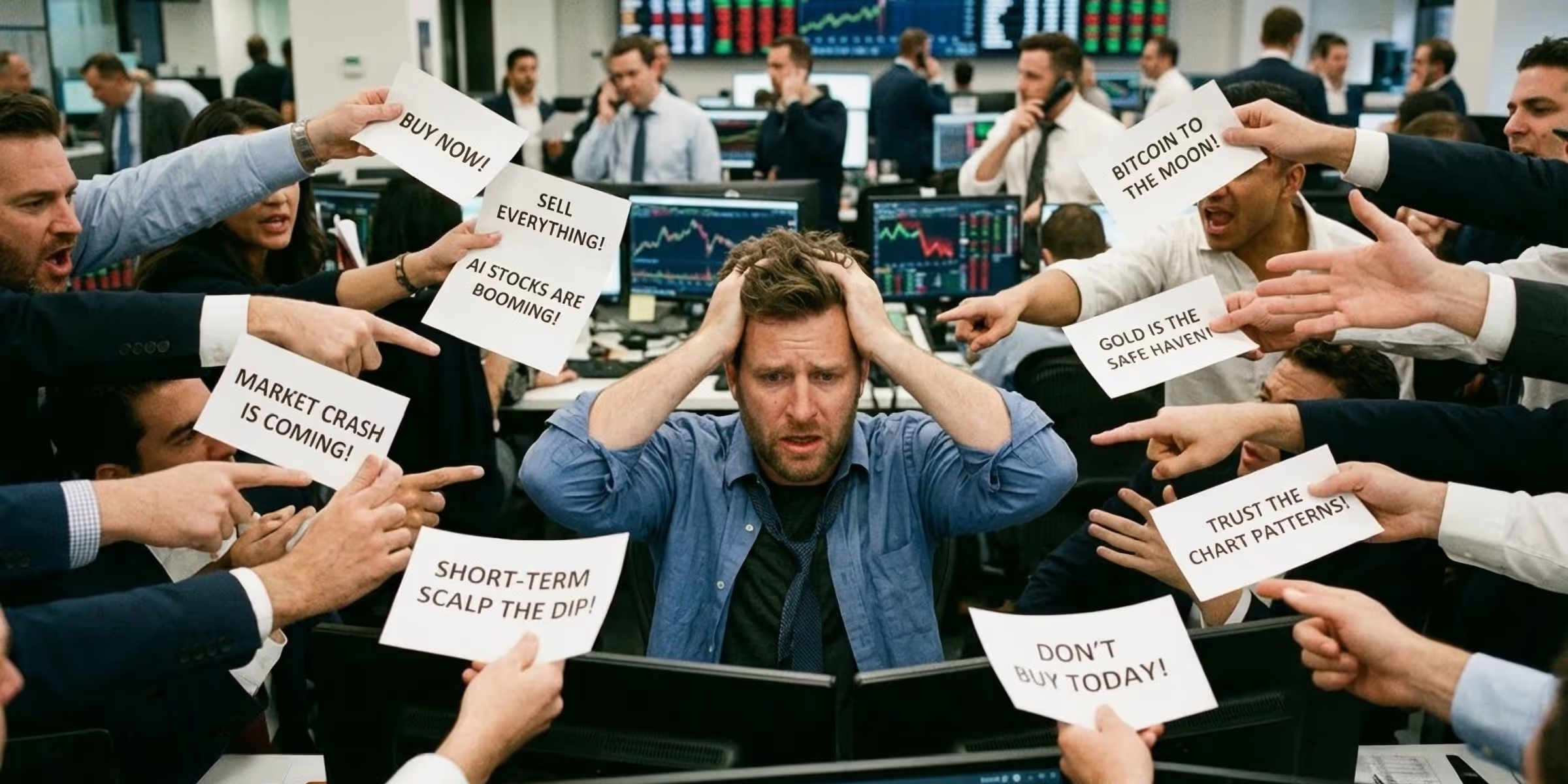
Now that we’ve covered what to watch out for when searching for trading information online, it’s important to look at the other side of the problem. What happens when a trader never develops their own system and instead constantly relies on other people’s ideas, tips, and signals? Let’s explore some of the common issues that arise when traders depend too heavily on external advice rather than building their own approach to the markets.
Misinformation that leads to early failure
When traders begin their journey with information based on false premises, such as the idea that trading is easy, that profits can be guaranteed, or that anyone can become a millionaire in a short period of time, failure becomes almost inevitable. These beliefs create unrealistic expectations that heavily influence both decision-making and trading psychology.
When someone enters the markets expecting fast and effortless profits, their focus shifts toward making as much money as possible as quickly as possible, often with very little capital. While this may sound appealing in theory, it is one of the fastest ways to lose all of your capital.
Trading is not a hobby or a shortcut to wealth. It is a demanding business that requires extensive knowledge, practical experience, disciplined risk management, and the ability to handle significant psychological pressure. When real money is at risk, emotions intensify, and without proper preparation and the right mindset, even small mistakes can quickly become costly.
Strategy hopping and lack of consistency
Unrealistic expectations often lead traders into another destructive habit: constantly changing strategies. When a strategy stops working for a short period of time, many beginners assume it has failed and immediately begin searching for a new one.
This behavior creates an endless cycle of learning new systems, abandoning them too quickly, and eventually becoming frustrated enough to quit trading altogether.
One important concept many beginners fail to understand is that no strategy works in every market environment. A strategy that performs well during a strong bull market may struggle during sideways or declining markets.
For example, if a buying strategy stops producing profits during a sideways market, it does not necessarily mean the strategy itself is flawed. It simply means the market conditions have changed. Instead of abandoning the strategy entirely, traders may need to temporarily switch to a different approach better suited to that particular market environment.
Unfortunately, many beginners interpret temporary underperformance as total failure and immediately start searching for a completely new strategy. This is a very common mistake that prematurely ends many trading careers.
Becoming dependent on other people's trade ideas
Another major danger of relying on other people’s trading ideas is psychological dependency.
When traders constantly follow signals, tips, or strategies developed by others, they slowly lose confidence in their own judgment. Instead of trusting their own analysis, they begin second-guessing every decision they make, assuming someone else always has a better setup.
A simple analogy can help illustrate this problem. Imagine driving a car while relying on GPS navigation for every trip. Over time, you may lose the ability to mentally plan your own route because you have become too dependent on external guidance.
The same thing happens in trading. When you constantly rely on others for ideas, you stop developing your own decision-making process. This dependency can become dangerous because trading requires independent thinking and confidence in your own analysis.
Even if someone else’s strategy is profitable, it will rarely work exactly the same way for another person. Every trader has a different risk tolerance, emotional response to losses, available capital, and trading schedule. Because of these differences, strategies almost always need to be adjusted to fit the individual trader using them.
Never developing your own trading strategy
If traders never recognize this dependency problem, they may spend years following other people’s systems without ever developing one of their own.
Without ownership of the strategy, there is little motivation to analyze and improve it. Traders may become afraid to make any changes because they worry about making mistakes or “breaking” the system they follow.
Professional traders approach this very differently. They constantly test, evaluate, and refine their strategies. They study their trades, analyze weaknesses, and make adjustments based on their own experience and the current market environment.
This process usually involves maintaining detailed trading journals, reviewing past trades, and continuously improving the system over time.
But this raises an important question: how can you truly improve a strategy if it does not belong to you?
Without understanding the reasoning behind the strategy or having the freedom to adjust it, meaningful improvement becomes nearly impossible.
Blaming others instead of taking responsibility
When traders rely entirely on other people’s strategies and fail to achieve the results they expected, they often fall into another trap: blaming others for their failures. In some ways, this reaction is understandable. If the strategy was not created by them, it becomes easy to place responsibility on the person who developed or promoted it.
However, this mindset prevents real growth.
Successful trading requires personal responsibility. Every trade decision ultimately belongs to the trader executing it. Without accepting responsibility, it becomes impossible to identify mistakes, improve decision-making, and develop stronger discipline. Taking responsibility can be uncomfortable because it forces traders to admit when they are wrong. But the reality is that being wrong is an unavoidable part of trading. Markets will prove traders wrong many times throughout their careers.
Learning to accept this fact and using it as an opportunity to improve is one of the most important psychological skills a trader can develop.
Unfortunately, many traders struggle with this step. The unwillingness to accept mistakes often prevents them from making the adjustments necessary for long-term success.
Learn From Others, But Do Not Depend on Them

In conclusion, learning from experienced traders, books, and educational resources is an important part of developing as a trader. However, knowledge from others should serve only as a foundation and not as something you depend on completely.
The real progress begins when you start thinking independently, testing ideas yourself, and adapting what you learn to fit your own personality, risk tolerance, and market understanding. Developing your own trading approach allows you to take full responsibility for your decisions, analyze your mistakes, and continuously improve your system. This process is what transforms theoretical knowledge into real skill.
In the end, experience gained through practice and independent thinking is what builds confidence, discipline, and the ability to navigate changing market conditions. Learning from others can guide you, but only your own experience can turn you into a capable trader.
Topics
Trading Myths

Beginner Trading
Technical Analysis
Market Education

Risk Management